Skip to content

Sculptural Art

Power carving gives sculptural artists the ability to work directly with form, flow, and texture — transforming raw material into expressive, dimensional artwork. Whether you’re creating abstract sculptures, figurative pieces, wall art, installations, or mixed-media work, power carving tools let you shape wood intuitively and bring ideas to life in three dimensions.

From subtle surface textures to bold, dramatic forms, power carving bridges the gap between traditional carving and contemporary sculptural practice — giving artists a fast, fluid way to explore shape, depth, and movement.

  • New

Loading image:
@bmsculptures

From Raw Materialto Sculptural Form

Sculptural art isn’t built from straight lines and right angles — it’s built from curves, transitions, and organic surfaces. Power carving allows artists to move beyond flat stock and rigid geometry by enabling:

  • Rapid material removal for rough shaping
  • Sculpting flowing curves and contours
  • Creating depth, relief, and dimensional form
  • Exploring negative space and undercuts
  • Developing surface texture and visual rhythm
  • Blending forms seamlessly

    Power carving doesn’t replace
    traditional carving — it expands it. It allows artists to work
    faster, more freely, and more experimentally while maintaining full
    control over the final form.
Loading image:
@bmsculptures

Why Sculptors UsePower Carving

Sculpture is about touch, movement, and physical presence. Power carving gives artists a direct connection between hand, tool, and material.
One of the biggest advantages of power carving — especially with Kutzall tools — is the ability to work across multiple materials using the same intuitive process.
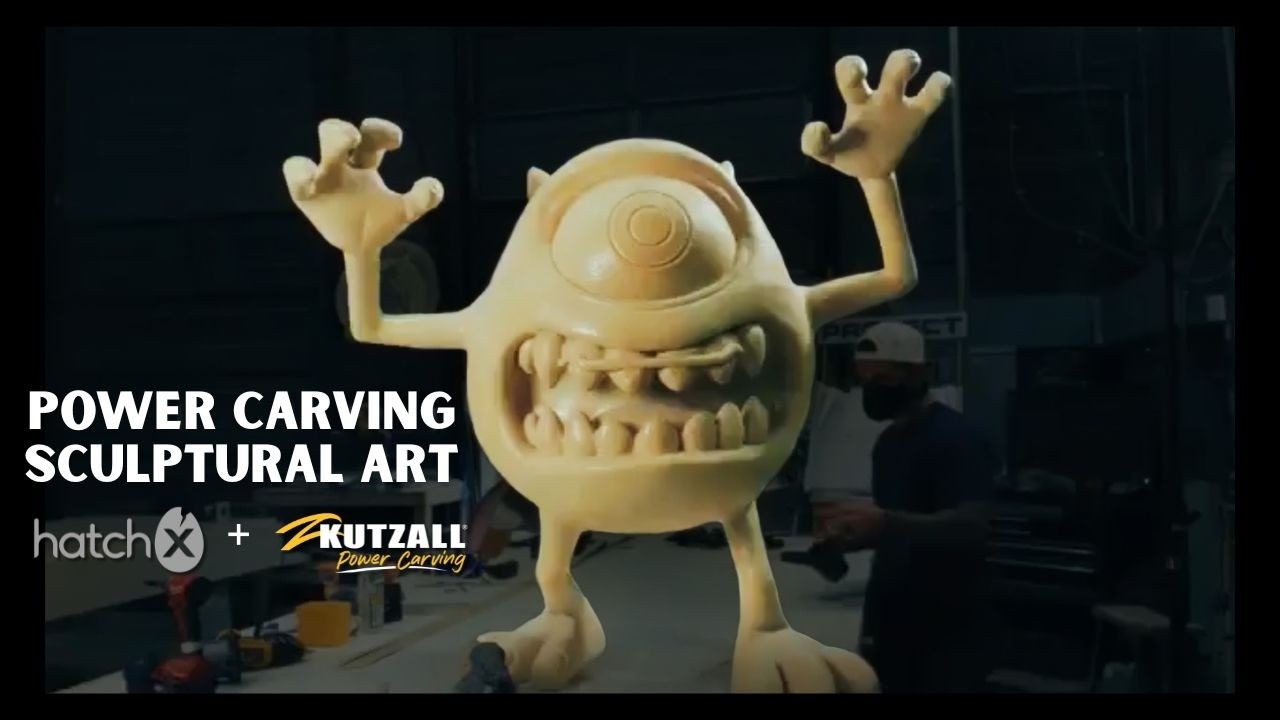
Kutzall power carving tools cut cleanly and predictably not only in wood, but also in foam, epoxy, resins, plastics, rubber, and many composite materials, making them ideal for contemporary mixed-media sculpture.

Common sculptural applications
include:

  • Abstract and organic wood sculptures
  • Figurative and anatomical carving
  • Relief carving and wall art
  • Textured surfaces and pattern work
  • Large-scale forms and installations
  • Blending carved and fabricated elements
  • Mixed-media and experimental artwork

    Whether you’re refining subtle
    transitions in hardwood or shaping bold forms in foam or resin, power
    carving allows you to work instinctively — responding to both the
    material and the evolving form of the piece.
Loading image:
@carving_fusion

Where PowerCarving Fits in the Sculptural Process

Power carving can be used at nearly every stage of sculptural creation — from rough blocking to final surface refinement.
It gives you direct control over:

  • Grain direction
  • Depth and aggressiveness of cut
  • Form development and transitions
  • Texture and surface quality
  • Undercuts and complex geometry
    This makes it ideal for:
  • Roughing out large forms quickly
  • Refining curves and proportions
  • Developing surface textures
  • Blending sculpted elements
  • Creating dimensional depth in relief work

    Power carving tools act like rotary chisels, allowing sculptors to shape wood intuitively — combining the speed of power tools with the freedom of hand carving.
Loading image:
@kywoodartist

The Right Toolsfor Sculptural Power Carving

Not all carving tools are suited for sculptural work. The best tools provide control, versatility, and durability across a wide range of materials and techniques.
When choosing power carving tools
for sculptural art, look for:

  • Smooth cutting action without chatter
  • Profiles for both rough shaping and fine detail
  • Clean performance on hardwoods and softwoods
  • Ability to create texture and flowing contours
  • Long tool life without clogging
  • Compatibility with rotary tools, die grinders, or flex shafts
  • Controlled stock removal for artistic shaping

Quick FAQ

Can power carving be used forfine art sculpture?

Yes. Many professional sculptors use power carving as their primary shaping method, especially for large or complex forms.

Is power carving only forrough shaping?

No. With the right profiles, power carving can be used for both aggressive material removal and fine surface detail.

Is this better than traditional hand carving?

It’s not a replacement — it’s an expansion. Power carving speeds up shaping so artists can spend more time refining form and finish.

What materials can be used?

Power carving works extremely well on hardwoods, softwoods, laminations, and many composite or reclaimed materials commonly used in sculpture.

Back to top